Saturday, May 7, 2016

Red Sea island transfer revives Egypt-Sudan border dispute - Al-Monitor: the Pulse of the Middle East

Sudan's President Omar al-Bashir (R) speaks during a joint news conference with Egypt's President Abdel Fattah al-Sisi in Khartoum, June 27, 2014.  (photo by REUTERS/Mohamed Nureldin Abdallah)

Red Sea island transfer revives Egypt-Sudan border dispute

CAIRO — The maritime border demarcation agreement under which Egypt ceded the Red Sea islands of Tiran and Sanafir to Saudi Arabia has brought back to the surface the dispute between Egypt and Sudan over the Halayeb and Shalateen triangle. While Khartoum insists on international arbitration or peaceful negotiations to decide the fate of this disputed region along Egypt’s southern border, Cairo refuses to discuss the issue.
Summary⎙ Print Hot on the heels of Egypt's recent ceding of Red Sea islands to Saudi Arabia, the country's row with Sudan over the Halayeb and Shalateen triangle has resurfaced.
Author Ayah Aman
TranslatorSami-Joe Abboud
On April 17, the Sudanese Foreign Ministry issued a press release in which it called for direct negotiations with Egypt in a bid to resolve the dispute over the region, similarly to what happened with Saudi Arabia, or for international arbitration, as provided for in international law, similarly to how Egypt regained the town of Taba from Israel in 1989.
The press release, which followed numerous unsuccessful diplomatic attempts aimed at starting negotiations with Cairo, emphasized that the agreement between Egypt and Saudi Arabia regarding the maritime border also affects Sudan given its connection with the two regions of Halayeb and Shalateen and the surrounding shores. “The Sudanese Foreign Ministry is closely following up on this agreement and its consequences to make sure it does not prejudice the sovereign, historical and legal rights of Sudan in Halayeb,” read the statement.
In response to the Sudanese request, the Egyptian Foreign Ministry issued an extremely brief statement April 18 saying, “Halayeb and Shalateen are Egyptian territories subject to Egyptian sovereignty, and Egypt does not have additional comment on the Sudanese Foreign Ministry’s statement.”
A diplomatic official working on the African dossier at the Egyptian Foreign Ministry told Al-Monitor, “Egypt categorically refuses to discuss the issue or to go for international arbitration, and it has made this clear to Sudan during several high-level and diplomatic meetings.”
The official, speaking on condition of anonymity, said, “There should be a political settlement to this issue, which is constituting a major obstacle to Egyptian-Sudanese relations.”
He noted that the Sudanese political administration is using the dispute over the sovereignty of Halayeb “to place pressure on Cairo regarding thorny issues. Chief among these is the Nile water and the Renaissance Dam crisis with Ethiopia.”
He added, “The negotiations between Egypt and Saudi Arabia over the maritime border demarcation agreement did not address the Halayeb shores of the Red Sea, and the issue was not raised in any of the official meetings.”
Sudanese President Omar al-Bashir had asked Saudi Arabia in October 2015 to take on the role of mediator between his country and Egypt to put an end to the conflict between the two countries over the Halayeb border triangle. His request came after Riyadh played a role in ending the crisis of the Sudanese miners detained in Egypt last year.
The dispute over the Halayeb region dates back to 1902, when the administrative border between Egypt and Sudan set by the British differed slightly from the border set by the Anglo-Egyptian Condominium in 1899. According to the 1899 boundary agreement, the 22nd parallel marked Egypt’s southern border, which indicates that the Halayeb region falls under Egyptian sovereignty. However, following Sudan's independence and separation from Egypt in 1956, the dispute arose over Egypt and Sudan’s inclusion of the Halayeb area within their administrative borders. This led Sudan to file a complaint against Egypt with the United Nations in 1958. Subsequently, Egyptian forces entered the Halayeb region in 1995 following the assassination attempt on President Hosni Mubarak as Sudan was accused of involvement.
Sudanese presidential assistant Ibrahim Hamid told Al-Monitor, “We are constantly seeking to prevent the border dispute from affecting our relationship with Egypt. We gave away Sudanese territory in the city of Halfa, which was completely submerged for the sake of the High Dam construction and the Egyptian people’s interests.”
“There is an African agreement whereby borders inherited from the colonial power should be respected in accordance with international treaties and agreements,” Hamid explained.
“According to the borders left by colonialism and signed by Britain and Egypt, the Halayeb region falls within the borders of Sudan,” he added, noting, “We have legal and historical documents signed by Britain and Egypt, and we have included these documents in the complaint filed with the Security Council.”
Observers of the Egyptian-Sudanese relations believe that the dispute over Halayeb and Shalateen has always been politically used in order to place pressure on Egypt. However, the dispute has never hampered cooperation between the two countries on other issues.
Hani Raslan, Head of the Sudan and Nile Basin Studies at Al-Ahram Center for Political and Strategic Studies, told Al-Monitor, “The dispute over the Halayeb region has not impeded the signing of important agreements with Sudan, knowing that the High Dam Convention was signed at a time when Sudan was filing a complaint against Egypt near the UN because of Halayeb.”
Raslan added, “Ever since Bashir's Islamist regime rose to power, it has been using the Halayeb issue politically against Egypt, as it resorts to domestic mobilization by creating a foreign enemy and portraying Egypt as a rival and sometimes an enemy. The Sudanese now feel that Egypt is treating their country condescendingly."
“The Sudanese administration is now using the dispute over Halayeb as a pretext to justify an alliance with Ethiopia against Egyptian interests in the Nile River water. Sudan is taking pro-Ethiopia positions in the construction of dams that pose a threat to Egypt's water security,” Raslan further commented.
He also ruled out the potential issuance of a Security Council resolution in favor of Sudan, saying, “Sudan is now an internationally isolated state due to US sanctions. In order for it to pass this resolution, it must have a strong international policy to be able to mobilize and convince the Security Council to consider this issue.”
The Halayeb issue remains a fundamental reason behind the chill in Egyptian-Sudanese relations and a direct threat to Egyptian national security, despite all of Cairo’s attempts to seek rapprochement with and give special attention to Sudan, which is a priority on the Egyptian foreign policy agenda.


Read more: http://www.al-monitor.com/pulse/originals/2016/05/egypt-halayeb-shalateen-border-dispute-sudan-saudi-tiran.html#ixzz47yh8gBVB

Ethiopia's army has entered South Sudan in search of 100 kidnapped children — Quartz

Ethiopia’s army entered South Sudan this week to search for over 100 children abducted by a South Sudanese militia during a cross-border cattle raid last month.


Ethiopia said the raiders killed over 200 people and blamed the attack on an ethnic Murle militia from South Sudan’s Boma area, which borders Ethiopia’s Gambela region.


South Sudanese authorities say Murle traditional chiefs are negotiating the children’s release to avoid military action, but Ethiopia’s entrance raises concerns that South Sudan government cannot control its own borders, so its neighbors are stepping in.


South Sudan has been embroiled in a bloody civil war the last two and a half years which has destabilized large parts of the nation and made its already porous borders susceptible to incursions.


President Salva Kiir warned last week that neighboring countries may take advantage of the chaos to push in.


“They can come in with their guns and do whatever they do,” Kiir said in an address to his ministers. “We don’t want this thing to continue.”


South Sudanese authorities insist Ethiopia’s incursion has been done with their full cooperation and approval, but Juba appears in the dark about the Ethiopian operation.


No one can say how many troops have entered South Sudan, and there seems to be serious lack of coordination within South Sudan’s own government.


The army, defense ministry, and the Boma government give different information about where the Ethiopian troops have entered South Sudan, and each have sent their own envoys to Addis Ababa.


South Sudanese authorities give conflicting stories about the chiefs’ rescue efforts, too.


The Boma government told Quartz 32 children were recovered, but presidential spokesman said 41. South Sudan’s army spokesman told Quartz he cannot confirm any children are saved.
This isn’t the first time neighboring countries or armed groups have infiltrated South Sudan to apparently capitalize on its civil war.
Last year, Uganda’s army entered the disputed Magwi area, while Kenyan soldiers pushed north to South Sudan’s Nadapal settlement near an oil-rich area.


Sudan to the north has also applied pressure by halting trade across its border to landlocked South Sudan while allegedly carrying out aerial bombings on South Sudanese territory in March.


Meanwhile, the Lord’s Resistance Army rebels of Joseph Kony reportedly entered South Sudan’s Raja County in the northwest this year after being based in nearby Sudan and Central African Republic.


Deadly cattle raids are common along the South Sudan-Ethiopia border often including abductions of children and women as wives or to care for stolen cattle.
Sign up for the Quartz Africa Weekly Brief — the most important and interesting news from across the continent, in your inbox.

Wednesday, May 4, 2016

“Politically Incorrect”: African Refugee Riots in Gambella Ethiopia, South Sudan and the Anti-China Plot


The fantasy of liberal ‘political correctness’ was shattered this week when a raging mob of South Sudanese refugees rioted in the western Ethiopian region of Gambella and killed at least 14 people.The rampage was sparked by a road accident in which an NGO vehicle crashed into and killed two young girls. The victims were Nuer and the car was driven by what some have termed a “highlander”, or an individual from the central mountainous regions around which the Ethiopian state historically crystallized, and this caused the majority-Nuer South Sudanese refugees to explode into an orgy of violence and carry out their killings. While the official death toll is slightly over a dozen people, another report cautions that it “could rise further since the refugees chased the victims to the forest, where they mutilated the bodies”. 41 refugees have since been arrested, but it’s unclear whether any more murder suspects still remain at large.Breaking The NarrativeNone of this was ever supposed to happen, well, according to Western Liberals and Cultural Marxists at least. In their ‘picture-perfect’ view of the world, only “racists”, “fascists”, and “white supremacists” would ever dare allege that overwhelming refugee influxes could destabilize host countries, but lo and behold, that’s exactly what happened in Ethiopia’s Gambella region. The western area of the country is hosting 270,000 mostly-Nuer South Sudanese refugees, despite only having an indigenous population of about 300,000. This has contributed to Ethiopia becoming the largest refugee-hosting country in Africa, and it also means that there are almost more refugees in Gambella than there are locals. Seeing as how most South Sudanese refugees are Nuer, this has destabilized the already tense ethnic balance in this part of Ethiopia and can be said to have demographically reengineered it to a large degree. Under such pressure, it’s little wonder that all that it took was a small-scale vehicular accident to put the region on the edge of civil war.
Political SabotageNot even a week prior to the refugee riots, South Sudanese rebels invaded Gambella, killed over 200 people, and kidnapped around 100 children, prompting the Ethiopian military to stage a cross-border operation in attempting to free them. This incident shook regional stability and showed that South Sudan’s conflict was increasingly spilling over the Ethiopian border, and no longer just in humanitarian terms, but militant ones, too. The timing of both of these attacks – the rebel and refugee ones – appears to have coincided with South Sudanese Vice-President Riek Machar’sreturn to the capital of Juba in order to implement the peace process that was agreed to in August. Tellingly, Machar, an ethnic Nuer, was in Gambella at this time en route to returning to his home country from the talks in Addis Ababa, and the Nuer refugee riots and preceding rebel raid might have been timed to sabotage his return at the last minute.
The Anti-China PlotTo expand on that idea, it actually makes sense if considered from a global strategic standpoint. South Sudan’s civil war has served the tangential purpose of unleashing a couple hundred thousand “Weapons of Mass Migration” against Ethiopia, which itself is a very ethnically diverse and demographically fragile state. In a sense, South Sudan’s post-independence destabilization can be seen as also achieving the goal of putting long-term asymmetrical pressure on Ethiopia through the planting of hundreds of thousands of identity-conflict “time bombs”, which is essentially what some of the Nuer refugees are regretfully beginning to function as. The reason that Ethiopia is being targeted with such uncouth weapons of war is because of its pivotal role in China’s global One Belt One Road network, particularly through the Chinese-built Djibouti-Ethiopia Railroad and the Chinese-financed LAPSSET Corridor from Kenya’s Lamu port to Ethiopia’s capital of Addis Ababa. Taken together, these two access routes will allow Ethiopia to unleash its full economic potential and become one of China’s closest multipolar allies, provided of course that a series of internal crises doesn’t offset that first.
Hybrid WarfareFor these reasons, the US would like to stir up identity conflict within the diverse state in order to incite another civil war there, but this time one which would result in the fragmented Identity Federalism of the country or its formal dissolution into a scattering of tribal- and ethnic-based states. The grand strategic purpose of China’s ambitious multipolar transnational connective infrastructure projects would thus neutralized in comparison to their original intent, fully in line with the “Law Of Hybrid War” which states that the US is seeking to provoke such identity conflicts for these very same purposes. In response to this Hybrid War threat, the Ethiopian government has tried hard to foster a strong sense of civilizational patriotism in order to unite its disparate ethnic and regional identity groups, but the threat remains that local differences could still be exploited by foreign factors in order to spark an uncontrollable conflagration of chaos.
Setting The StageThe author wrote about the latest attempt to use identity conflict as a trigger for a nationwide crisis at the end of last year when the Oromo, the largest ethnic plurality in the country, staged a series of high-profile riots in response to the government’s controversial use of eminent domain. Prior to that, the author also wrote two related pieces, one for Katehon and the other for The Saker, about how the GCC is planning to use Eritrea as a launching pad for anti-Ethiopian activity in the future, predictably through the provocation of internal identity conflict. The former article specifically warned that the “current tribal violence in South Sudan (could) motivate a spillover effect into the neighboring Southern Nations, Nationalities, and People’s Region (home to 45 different ethnic groups) or Gambella Region that ‘naturally’ creates the state-fragmenting process”, and as fate would have it, part of that forecast has already come true with the South Sudanese refugee rampage in Gambella and the preceding cross-border kidnapping raid. Although the situation presently appears to be under control, it can’t be certain that a repeat of either of these two conflict triggers will occur, especially considering that the nearly 300,000 refugees in Gambella could once more fall victim to manipulative crowd control techniques in turning them into “Weapons of Mass Migration” for indirect use against China.
Concluding ThoughtsTo wrap up the article, it’s important to return back to its title and speak about how the weaponization of South Sudanese refugees against Ethiopia disproves one of the foundational tenets of modern-day “political correctness”. It would never be countenanced by Western Liberals and Cultural Marxists, let alone admitted after the fact of its provable occurrence, that refugees could be used to destabilize their host country, let alone when the evidence of this happening is of African-on-African aggression. The post-modern employment of “Weapons of Mass Migration” is a very real phenomenon that the author investigated in a two–part series earlier in the year, but in this specific context, it’s being leveraged against China’s New Silk Road interests in the Horn of Africa.
The “political incorrectness” of what happened in Gambella doesn’t take away from the destabilization that it caused, and ignoring the on-the-ground facts in favor of maintaining ideological “clarity” and “consistency” results in nothing more than the creation of an imagined reality that’s completely divorced from actual events. Moreover, denying that “Weapons of Mass Migration” exist actually ‘legitimizes’ “Israel” and enables the use of such unconventional strategies against other multipolar countries as well. Therefore, it must be underscored that the sooner that observers come to recognize the use of this enhanced form of post-modern weaponry, whether waged indirectly against Russia by using Arab refugees in Europe or against China through the utilization of South Sudanese ones in Ethiopia, the sooner that they can collectively put their energy together in exposing other similar such plots and devising appropriate countermeasures in responding to them.
The original source of this article is Global Research
Copyright © Andrew Korybko, Global Research, 2016

European Union calls for return of abducted Ethiopian children

Ethiopian army tries to rescue kidnapped children after 208 killedEuropean Union calls for return of abducted Ethiopian children May 02 12:44 2016 By Timmy Brock Ethiopian forces may cross into South Sudan to pursue them, he said. South Sudanese leaders are trading accusations over who is responsible for a cross-border attack in Ethiopia which Ethiopia's government said resulted in deaths of 208 people and triggered an incursion by Ethiopian troops into South Sudan. "You know in South Sudan we have even cattle rustlers and this is the situation which is happening", he said. In response to the attack, Ethiopian government soldiers have reportedly chased the attackers and killed 60 Murlie perpetrators. Acting Foreign Minister Peter Bashir Gbandi said South Sudan's army was not involved in Friday's attacks. The raids last week happened in three districts of Gambela, in the country's west, when attackers from neighbouring South Sudan crossed into Ethiopia. The region hosts thousands of South Sudanese refugees who fled when war broke out in December 2013. More than 100 children kidnapped and taken to South Sudan last week have been found by the Ethiopian army. "The EU expresses its condolences to the families of the victims and calls for the South Sudanese authorities to ensure the immediate return of the abducted children to their families and that those responsible for this act of violence are held accountable". The Murle, a tribe from South Sudan based in the eastern Jonglei region near the Ethiopian border, often stage raids to steal cattle and abduct children but very rarely on such a large or deadly scale. Ethiopian officials say members of the Murle ethnic group are to blame. Ethiopia believes the raids are not linked to the ongoing conflict in South Sudan. "We have to neutralize the threat, hold whoever perpetrated these heinous crimes to account", Ethiopia's communications minister, Getachew Reda, told CNN by phone from Addis Ababa, the capita State of the State Ks http://stateofthestateks.com/2016/05/02/european-union-calls-for-return-of-abducted-ethiopian/

Monday, May 2, 2016

Ethiopia opens talks to secure release of at least 100 hostages

Ethiopia opens talks to secure release of at least 100 hostages

32 abducted Ethiopian children recovered in South Sudan

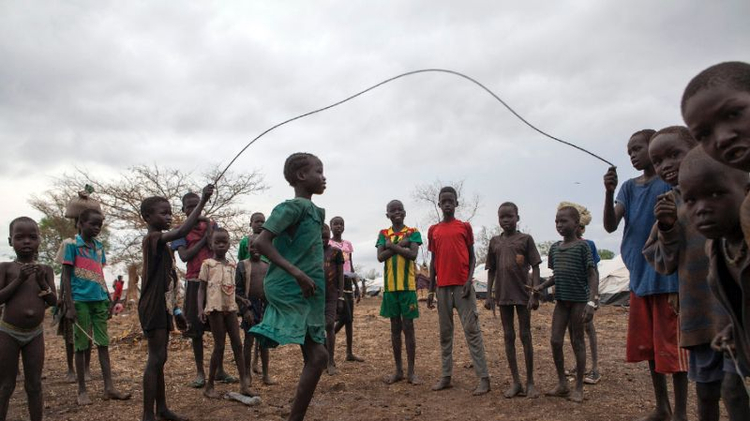
Children jump rope in the Kule refugee camp near the Pagak border entry in the Gambela Region of Ethiopia on April 2, 2014


---


More than 70 children still missing from cross border raid carried out by South Sudanese militants on April 15
Thirty-two of the over 100 Ethiopian children who were kidnapped from the country's Gambela region two weeks ago have been recovered, authorities in South Sudan told theAssociated Press (AP) on Saturday.
More than 200 people were killed and 102 children abducted by armed men from South Sudan in a cross-border raid into Ethiopia on April 15.
The assailants, armed with Kalashnikov rifles killed anyone who opposed them, according to witnesses. They also stole over 2,000 livestock.
Acting governor of South Sudan's Boma state, Ogato Chan, told AP that the children had been dropped off by their captors in three different villages in South Sudan's Likuangole County.
The children will now be transported to the country's capital, Juba, and then relocated back to Ethiopia, said AP.
"The chiefs are looking for the rest of the children," Chan said.
According to AP, Gambela regional president Gatluak said that he has not received any information about the recovery of the children.
Ethiopian officials blame Murle tribesmen from South Sudan for a series of deadly attacks on Ethiopian villages in the western Gambella region.
The Murle, a tribe from South Sudan based in the eastern Jonglei region close to the Ethiopian border, often stage raids to steal cattle and abduct children but rarely on such a large or deadly scale.
The deadly raid has unleashed a wave of anger and boosted fears that the civil war raging in South Sudan could spill over the border.
Ethiopia has been heavily involved in the South Sudan peace process, partly because of the risk that the conflict could destabilize Gambella, 50 kilometers (30 miles) from the frontier.
After winning independence from Sudan in 2011, South Sudan descended into war two years later, setting off a cycle of retaliatory killings that have split the poverty-stricken country along ethnic lines.
Tens of thousands have been killed and over two million people forced to flee their homes.
Both the government and rebel sides have been accused of perpetrating ethnic massacres, recruiting and killing children and carrying out widespread rape, torture and forced displacement of populations to "cleanse" areas of their opponents.